
From The LCM Archive: What the Heroes of 9/11 are Teaching Students – One Year Later
Originally Published August 2002
“In giving you are throwing a bridge across the chasm of your solitude.” – Antoine de Saint-Exupéry, The Wisdom of the Sands.
Last November’s issue of Lancaster County Magazine included a story called The Gift of Gatorade. It told of the students at Nitrauer Elementary School, in the Manheim Township School District, who organized a Gatorade drive for NYC firefighters. They shipped nearly 700 one-quart bottles to the embattled firefighters who were struggling to maintain their energy during the initial days of the World Trade Center recovery and clean up. Halle Bryan, a second-grader at the time, received a letter from Doug Hantusch, a NYC firefighter, thanking her for the note she sent along with her donated Gatorade bottle.
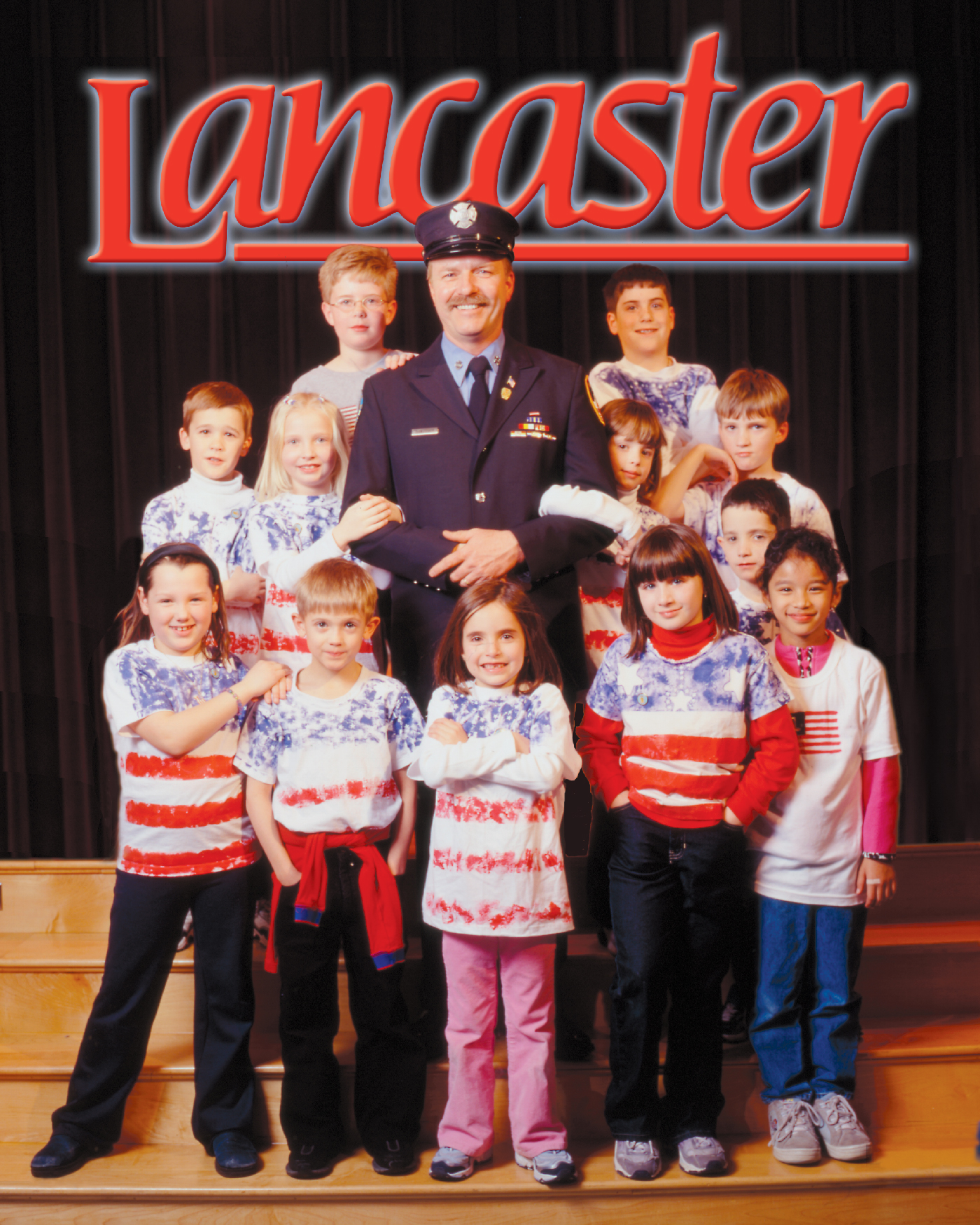
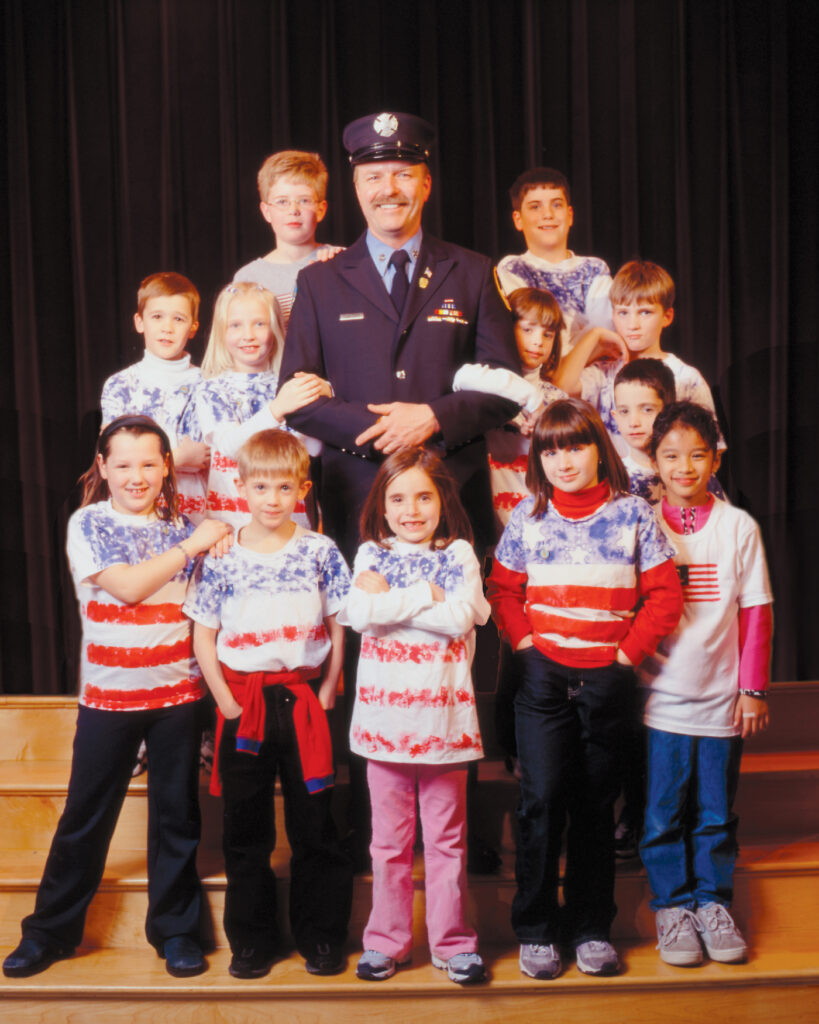
When Hantusch went one step further and visited the students at Nitrauer, we were so moved by those gestures of kindness that we decided to feature Hantusch, Halle Bryan, and several other students, on our cover this month as a tribute to the strength of the human spirit.
The experience of seeing the children clamor to sit on Hantusch’s lap, or wear his hat, made us wonder what students would remember about September 11. It made us want to examine the hearts of area students to understand their perspective on world events – and just what it takes to grow up with skyscrapers literally falling down around you.
What we found is that American students are standing strong – expanding their hearts to others whose hearts may be broken.
The Second Effort
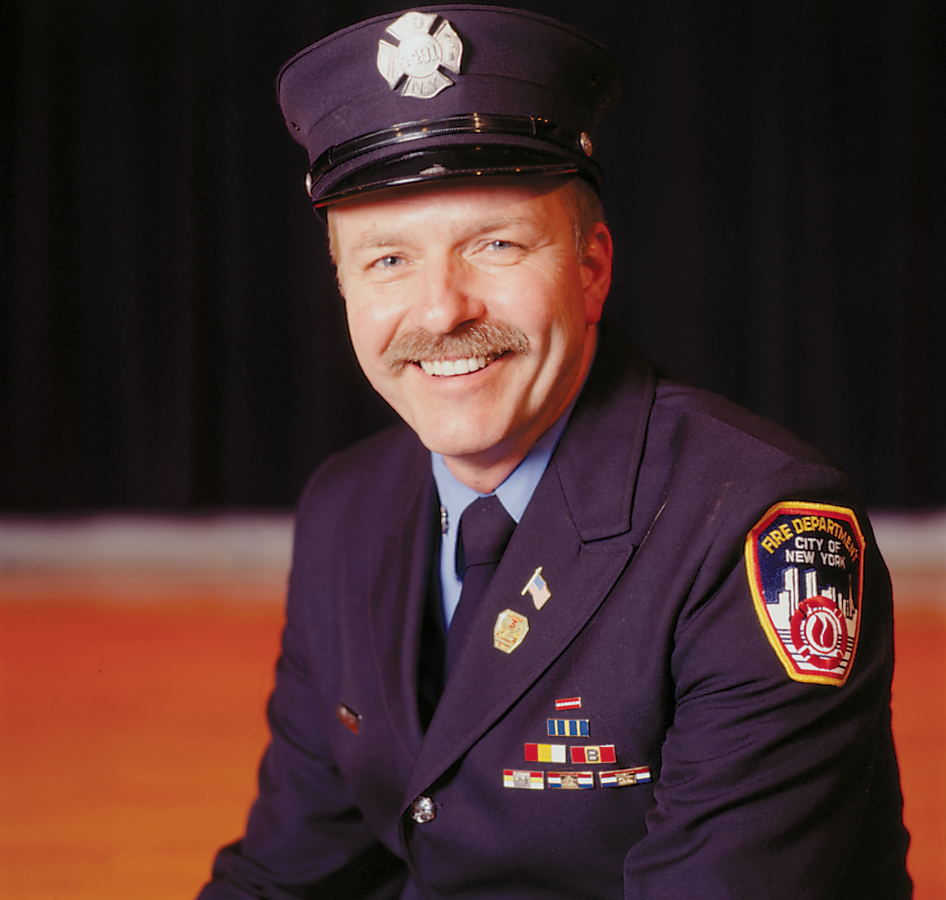
Doug Hantusch, who has been a member of the Fire Department of New York (FDNY) for 19 years, spoke with me about September 11, the day he received Halle Byran’s note, and what he hopes this country’s children will learn from that day.
Hantusch was at home in Montgomery, New York, that September 11 morning. Then, one of his friends, Mickey, called to tell him that a plane had just crashed into Tower One.
Immediately, he and his wife Margie turned on CNN. “I remember taking a sip of coffee – the cup was right at my lips – and the second plane crashed [into Tower Two].”
While firefighters “unfortunately get used to [tragic events],” Hantusch says, “I don’t think anyone in this job had ever seen anything of that magnitude.” Before the FDNY put out what Hantusch says is a “Total Recall,” meaning every single member must report to a scene, he and Mickey had jumped into a truck and started racing the 68 miles toward Manhattan.
“I’ve been involved in a lot of high-rise fires,” Hantusch says, “but never in my wildest imagination would I have thought that those [towers] could come down.” The unspoken question was, “Where are our guys?” he says. “There was a deafening silence as we drove.”
Eight members of Hantusch’s unit – Rescue Co. 3, with a total of 25 firefighters and four officers – were killed on 9/11. Only two bodies were recovered – those of Jerry Sherang and Tommy Foley.
Hantusch and Mickey reached the Grand Concourse in the Bronx only 10 minutes after the second tower collapsed. They grabbed gear, a pick-up truck, and hand tools – a skeleton of rescue implements – and rushed straight toward the gaping hole in the sky where the towers once stood. “It was the most eerie sight I’ve ever seen,” Hantusch recalls. “All of downtown was a plume of smoke. There was a mass pilgrimage of people on FDR Drive. They were covered in dust except for their eyes and mouths. Their clothes were ripped. When we got out of the truck [near the scene], you didn’t hear your feet hit the ground; [the dust] was just like snow.”
As an employee for the General Services Administration, Hantusch worked for many years directly across from the World Trade Center. “I was always so impressed by those buildings,” he says. “They were just so big … it was really a miracle.”
What Hantusch discovered of the towers, though, on September 11, was “twisted wrecked steel, and fires in high-rises [on the perimeter]. On West and Liberty streets, entire floors of high-rise buildings were blowing fire out of them like you wouldn’t believe.” Hantusch and other firefighters were ordered to do something unnatural for them – they were told to ignore the surrounding fires and begin digging through rubble to search for survivors or bodies. “It was the most helpless feeling,” Hantusch admits.
Ignoring the surrounding fires was akin to neglecting their own children. They tried to “shake it off and pick a task,” which was primarily assembling into teams and dividing Ground Zero into search-and-rescue zones. The steel beams that had framed the towers looked “as if you took modeling clay,” Hantusch describes in the only way he knows how, “and ripped it in half.”
Dividing the site, in itself, seemed impossible. No reference points remained. But quitting wasn’t an option. “There was no particular place to start,” he describes of the cleanup efforts at Ground Zero. “It was just, ‘Get to work.’ It looked like Armageddon. Fire trucks that weighed 60,000 pounds were crushed like soup cans, trapped under rubble.” Although a special-operations unit with sophisticated equipment, Hantusch says, “We couldn’t cut through the steel. It was no match for what we were faced with.”
Steel Workers came to their aid. “There’s not a better group of guys,” Hantusch believes. “They are the experts. These guys hung tough with us every inch of the way. They worked with care and compassion.”
On the first day, Hantusch and his colleagues discovered a woman lying on top of the rubble. “She rode the building down,” Hantusch says, “and survived.” Later, they found a void filled with bodies in a collapsed stairwell. “These bodies were so badly broken,” he remembers, unable to continue. “We worked there hour after hour.” The next day, they found no one. “We had the hope that people would be found alive,” he says, “but as the days went by, we realized that wouldn’t be the case.” (As of late June, 19,000 body parts remained to be identified through DNA analysis.)
On the second or third day at Ground Zero, his home for the entire first week, Hantusch remembers, he was working in a void 150 yards deep in rubble. To reach the surface, the firefighters had to use ropes, ladders and pulleys to navigate through the molten steel. Hantusch began to journey toward the top for fresh batteries, tools and water.
At the “Cash,” where all the supplies were housed, Hantusch filled spackle buckets full of supplies and headed back to the void. As he passed a tent set up by aid workers, someone handed him a bottle of Gatorade. Not wanting to leave his colleagues in the void for an extended period of time, Hantusch quickly sat on some rubble to guzzle the Gatorade. That’s when he discovered Halle Bryan’s note.
“The most poignant thing about Halle’s note was that she signed it and drew a heart in between the two Ls,” he remembers. “When I saw that, I just started sobbing. It made me think about the rest of the country.” When Hantusch went home a week later, he again came across Halle’s note in his gear bag and just knew that he had to visit her.
“I felt that it was just something I had to do.” He wrote a letter to her and to Kathy Schotta, Halle’s second-grade teacher at Nitrauer Elementary. “What a credit to the teaching profession,” Hantusch says of Schotta. “Our whole world was Ground Zero and the fire department,” he says of the days following the terrorist attacks. Whenever the Nitrauer students sent him letters, “it was like a 10-minute reality break.”
Coming to visit the school was also a reprieve from the chaos. After two days in Lancaster, Hantusch realized that “the rest of the world was behind us. You would sit [amongst the rubble at Ground Zero] and feel that the rest of the world was praying for you.”
“A lot of us sit around the firehouse now and we realize how much we took for granted on September 10,” Hantusch reveals. Rescue Co. 3 is “a very highly trained group of individuals,” working with “specialized equipment” and trained in everything from hazardous-materials cleanup to water rescue and SCUBA. Hundreds of hours are invested in each firefighter’s training. The loss of its entire on-duty company that day also left the group with few remaining people equipped with the skills necessary to tackle the cleanup/recovery effort. To train new recruits, the remaining firefighters took turns – and continue to do so – teaching at the technical rescue school. “I’m honored to be part of this group. I really feel like the Lord has blessed me by being a NYC firefighter. We’re going to put this thing back together,” he declares through tears. “The guys that we lost wouldn’t have wanted us to quit.”
A father of three children, Jill, 19, Kevin, 18, and Karen, 16, Hantusch is also fiercely proud of how his family coped through the ordeal. “My family has been really great through this whole thing. I would not want my children to take their freedoms and benefits as Americans for granted,” he adds. “I hope that my kids realize what a privilege it is to be an American.”
Despite the dangerous working conditions and inadequate pay, these firefighters persevere – a trait Hantusch inherited from his father, who was a WWII fighter pilot in the 100th Bomb Group. The elder Hantusch passed away just before September 11, at the age of 80. “I can’t tell you how much respect I’ve gained for my father. I think I can feel a little closer to all the things they have done,” Hantusch says of ‘The Greatest Generation.’
The one-year anniversary will mark “a time when the dust will begin to settle on this thing,” Hantusch says, unsure of what his emotions will be on that day. As an older friend, who was also in WWII, told him, “‘You never leave it behind you, Dougie. You have to carry this with you for the rest of your life.’ I hope I carry it with the dignity that he does,” Hantusch says.
“The greatest heroes [of September 11] are gone,” he adds. “They died that day. We just tried to find them.”
Nine months after September 11, Ground Zero ceased to be a search-and-rescue site. Hantusch and his colleagues brought the wives and children of fallen firefighters to the ceremony marking the end of the rescue effort.
For children trying to grow up in this world, Hantusch says, he hopes that “when the chips are down and there’s a task ahead of you that looks like it can’t be finished, don’t give up. That’s no excuse to give up. Push deep down to take out what we call, ‘The Second Effort.’ Take that to finish the job,” he says.
As for the rescue and recovery efforts at Ground Zero, “It wasn’t just firefighters,” he says. From the person who handed him the Gatorade bottle, to Halle Bryan, to the residents of New York City, so many people gave of themselves in September 11’s aftermath.
Driving down the West Side Highway, which skirted the towers, “thousands of people would [gather] there just to say thank you. They would throw kisses and bottles of water. It was hard to drive up the West Side Highway without a dry eye. I saw a side of New York City that has changed me forever. They’re good people. We got through this thing. I just hope and pray that we keep going on the same road. We, as New Yorkers, as NYC firefighters, are really grateful for everything they’ve done.
“Please know,” he adds, “that they’re all in our hearts – we appreciate [the nation’s efforts] more than they’ll ever know,” Hantusch states. Therefore, American children “are going to remember this,” he says, “and it’s going to form who they are. I’ve got faith that these kids are going to show what they are when they grow up to be adults … and that’s good people.”
About the Writer: According to LinkedIn, Julie Cramer is a marketing editor for the civil engineering firm, STV, in Charlotte, NC
Leave a Reply